
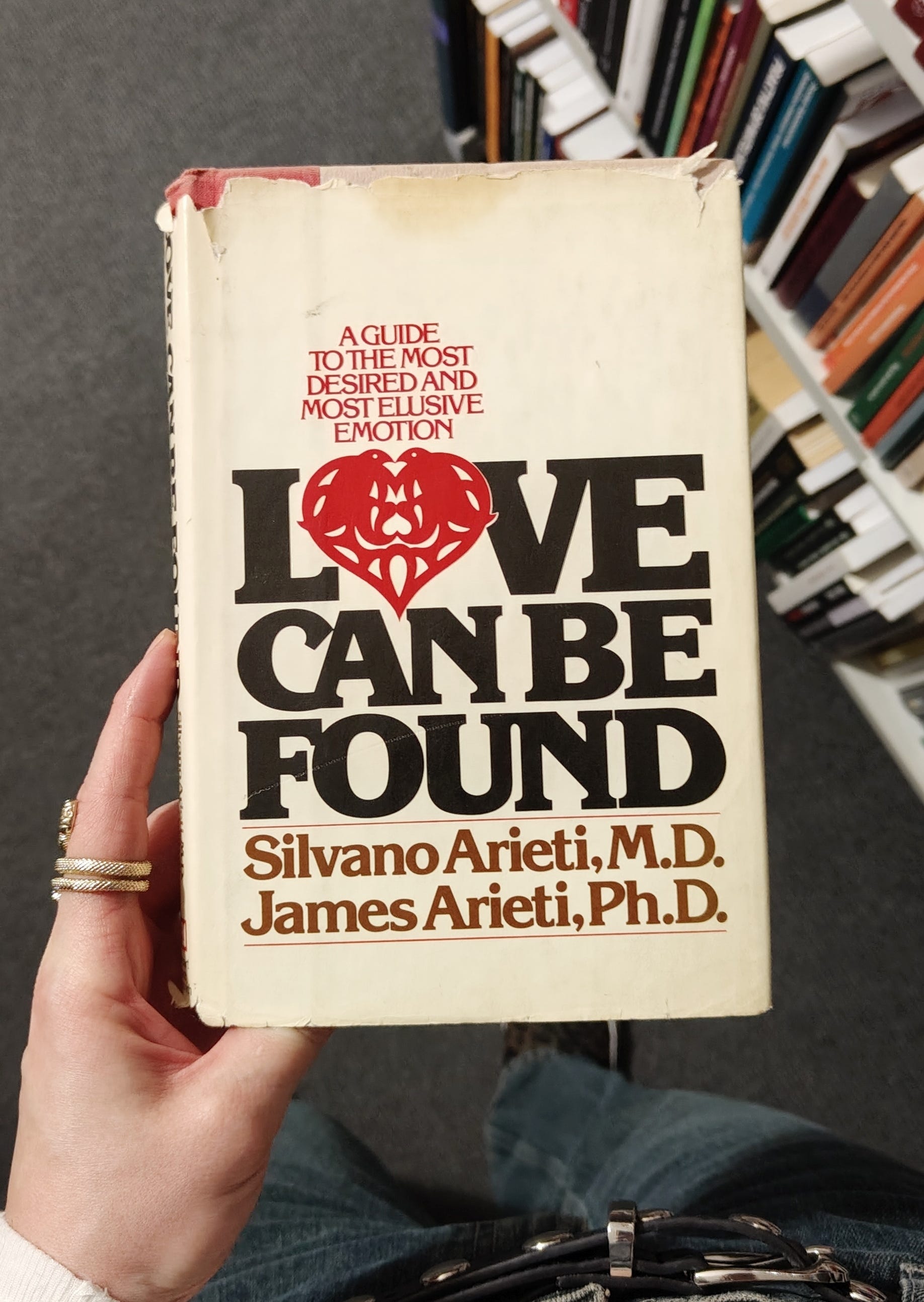
love can be found

A guide to the most desired and most elusive emotion.
If we take into account that there are seven types of love distinguished by the author, we could consider that this division is produced by the individual capacities of a person to love.
This would allow us to view love as a series of levels to be passed through. We could move through each level with a different partner, reaching a certain cognitive capacity and then finding another partner to pass through the next level of love.
We could also move through all these levels with one constant partner - completing every level with the same person.
The results in terms of life satisfaction, based on these two scenarios, would be entirely different.
Where, then, does it become clear how an individual should decide which scenario they are better suited for?
In Hesiod’s Theogony, love is presented as a divine creative force. In Socrates’ speech on love in the Symposium, and later in Augustine and Aquinas, love appears as a force of rehabilitation — a state that compels transformation and movement toward a higher level.
“ According to the testimony of Aristotle, Hesiod and Parmenides were the first to suggest that love is the force which moves things and keeps them together. Empedocles, too, saw in love the force which keeps together the four elements (fire, water, earth, air). According to him, the kingdom of love is the culminating phase of the cosmic cycle, during which all elements are together in complete harmony. “
Knowing this from the literature about the function of love, we should therefore focus on identifying the moment when stagnation and the cessation of growth occur.
When do we know that a partner no longer fulfills their transcendent role — the role of completing cosmic cycle and elevating the other person?
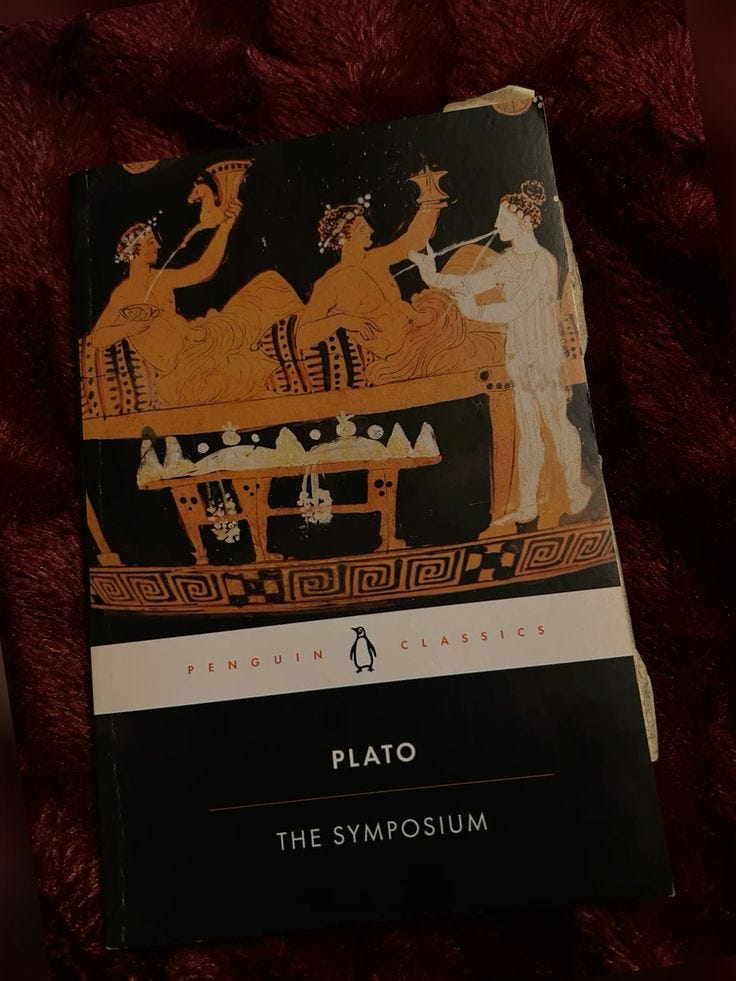
Socrates said that his knowledge of love came from the priestess Diotima of Mantinea. Therefore, the fragment comes from Socrates’ speech in the Symposium, but it is actually Diotima’s speech, which Socrates recounts:
“Love is a great daimon, Socrates; for all that is daimonic is intermediate between god and mortal.” (Plato, Symposium, 202d–202e, trans. Christopher Gill, Penguin Classics)
Love is neither a god nor a human. It is an intermediate, undefined state. Therefore, it is something that exists between two poles.
“Does he desire what he is and has, or what he is not and does not have?(Plato, Symposium, 200a)
“He desires what he does not have and what he is not.” (Plato, Symposium, 200a–200b)
An extraordinarily simple bluntness of obviousness. If you have something, you do not desire it, and vice versa. Therefore, love always arises from lack.
“Love is of possessing the good forever.” (Plato, Symposium, 206a)
“Love is of immortality.” (Plato, Symposium, 206e)
A rather naive and egoistic desire of the human being to transcend their own mortality. They do this through reproduction - children - and through works in the form of music, paintings, and science.
If we possess love, we possess longevity.
The memory of us will remain forever. We may venture the judgment that love is a tool for overcoming mortality.
“Suddenly he will catch sight of something wonderfully beautiful in its nature; this, Socrates, is the reason for all his earlier labours.” (Plato, Symposium, 210e–211a)
“He will catch sight of beauty itself, absolute, pure, unmixed, not infected with human flesh or colours or any other great nonsense of mortality.” (Plato, Symposium, 211a–211b)
The ladder of love. The stages a person passes through: love of one body, love of many bodies, love of the soul, love of knowledge, and ultimately - love of the form of beauty itself.
This is the moment when a person no longer defines love as directed toward another human being, but toward something eternal and, most importantly, unchanging.
Its function transforms from biological into epistemological.
“All human beings are pregnant, Socrates, both in body and in soul. (Plato, Symposium, 206b)
“When they reach a certain age, our nature desires to give birth.” (Plato, Symposium, 206c)
One of the most fascinating moments - we are all pregnant. The human being is “pregnant,” both in body and in soul, and thus the fruits of this pregnancy take different forms.
It may be a child, but it may also be a painting, philosophy, a theory, or an idea.
The artist, philosopher, or scientist becomes the mother. All of this can outlive us - all of it leaves a trace - all of it fulfills the role of longevity and a break from mortality.
We do not need other people for love.
Pregnancy, in each case, looks entirely different, but its meaning remains the same.
Love thus appears to us as a fruit.
Different degrees of force are required to bring something into being. Sometimes the emotional turbulence caused by love cannot be described in words, and it then transforms into action.
From the helplessness of feeling, we enter into a beautiful act - the act of doing.
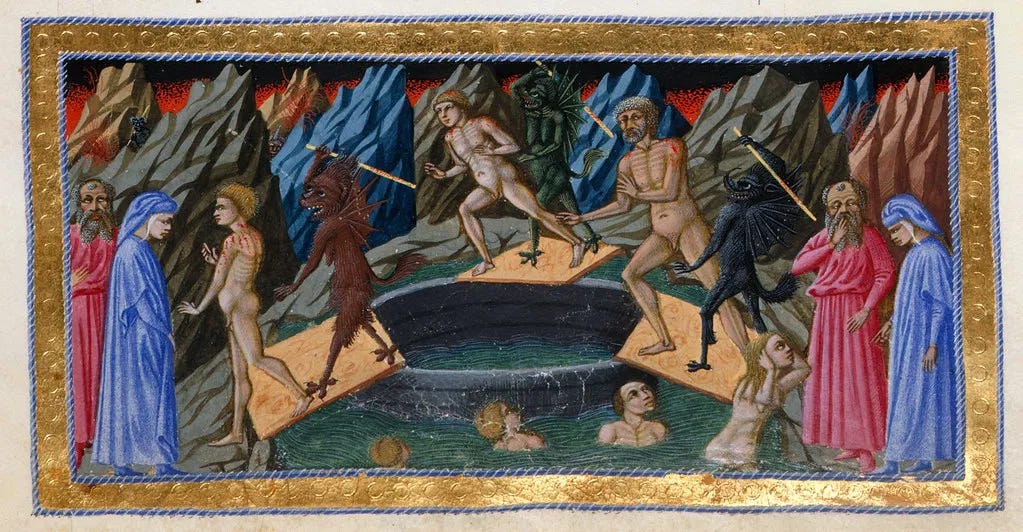
“Dante experienced his love for Beatrice as a journey transcending whatever is human and terrestrial and leading to salvation and encounter with the Divine.”
Love can be the cause of decisions to cross boundaries we had never even dreamed of before. It can also reveal within us abilities we would never have suspected ourselves of possessing. It can lead to wars and to redemption, to happiness and to pain.
Yet the goal remains the same - transformation.
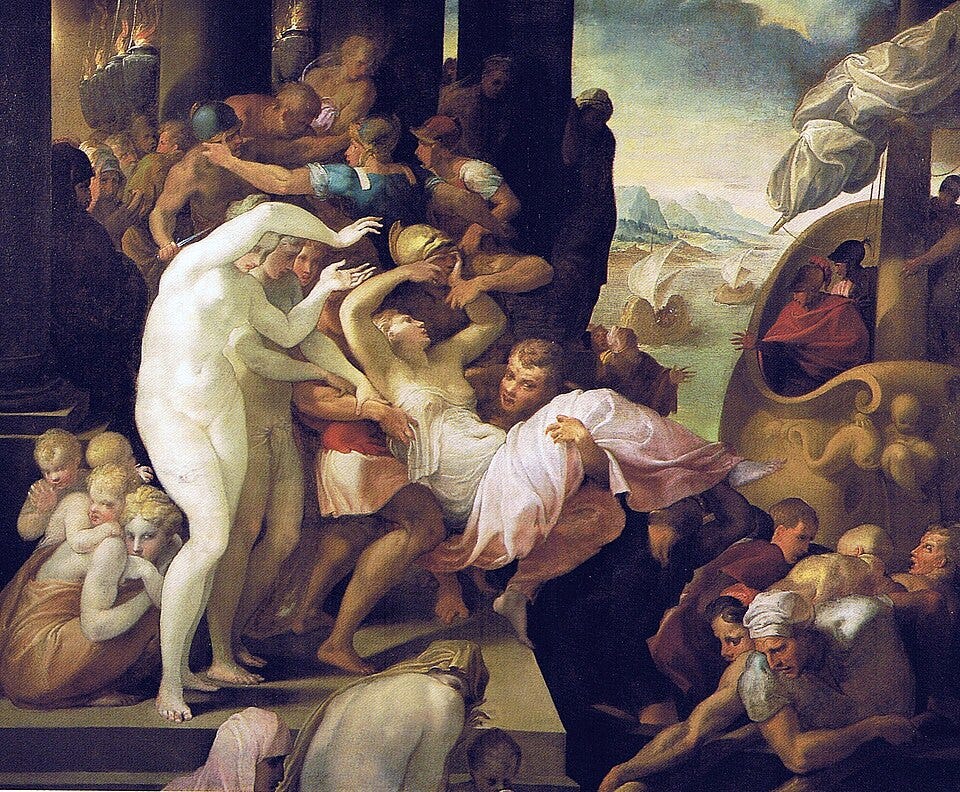
“A passionate love for the beautiful Helen caused the Trojan War, the conflict which has astonished Western minds for more than 2,500 years because of its ferocity and primacy in time and because it inspired Homer’s Iliad, the noblest epic of the West. “
Yet claiming the right to love is not so simple. Everyone is capable of love - the problem lies in practice: how can we love when we are filled with fear?
Human beings naturally carry different fears within themselves; it depends on the environment they inhabit, where they live, and how old they are.
Yet the problem remains the same - the attempt to love or to create something from love arises from the annihilation of fear, from stripping it of all its layers, understanding it, and letting it go.
It is the taming of fear that allows us both to enter into love and to leave a love that no longer allows us to move to the next stages.
“The number of people who have experienced no love at all is infinitesimally small and that people who have never been afraid are non-existent. All of us are gripped by fear in some circumstances.
Unfortunately these two emotions are often disproportionately distributed in our life: too much fear, too little love.
When we pursue love, we must have both the courage to love and the courage to confront fear.”
Confronting one’s fears allows, among other things, for the mutual growth of individuals within a relationship. A disruption of balance in growth threatens the collapse of that growth.
“If love is to be preserved, both partners must have opportunities for growth.
Again, if there is no possibility of growth for both partners, marriage is not a fulfillment of love, but is a restrictive, demoralizing imprisonment.
Parasitism, in the sense of one of the partner’s living at the psychological expense of the other, or symbiosis, in the sense of both partners’ finding sustenance or worth only in the other, can develop.”
One of the abilities we possess through encountering love is the possibility of overcoming our fears. It is possible that alone we would not be able to climb so high, because the motivation would not be sufficient.
When love is at stake, such a reckoning looks different.
Thus, when two people grow, the relationship can extend its roots and build a foundation which, when properly nurtured, will bear fruit for both sides.
By neglecting one side, we incur a lasting loss; certain transformations cannot be reversed, and reaching the level of the other person eventually seems to require too much time.
Consequently, a thought emerges: it is time for a new partner.
“Many people believe that a marriage that began well will proceed well, possibly for the lifetime of the spouses. Again we must stress that nothing in the marital situation should be taken for granted. Even when marriage was motivated by genuine love, there is no guarantee of lifelong happiness. Certainly a good beginning is better than a bad beginning, but it is only a beginning. Like freedom, love must be preserved and cultivated. Complacency is to be avoided.”
The art of creating love is also an aspect that cannot be regarded as a guarantee.
Love does not present itself as something secure, but rather as a constant state of alert — one wrapped in a beautiful, sweet exterior that conceals the brutality of continuous updating: of mutual needs, of courage on both sides, and of discipline.
This is the price we pay.
Being alone, we pay. Being with the wrong partner, we pay.
Being uncommitted within a relationship, we also pay.
Love is not an end in itself; it is a tool that allows us, or helps us, to transform from a larva into a butterfly — or in the opposite direction. Diotima’s ladder of love, as recounted by Socrates in the Symposium, makes this clear. The other person — the one we choose — is a catalyst. The partner is a stage.
Thus, the culmination of transformation as a human being leads us toward beauty. Therefore, when a partner no longer enables growth, it is we, as individuals, who have reached the limit of growth within that particular relationship. This occurs on our side, not on the partner’s.
We change partners not because growth is impossible, but because reaching for growth within that same structure becomes too disturbing, too painful — it begins to appear almost impossible.
At the same time, the growth we dream of may seem attainable at the side of another completely new person.
// “Love can be found” Silvano Arieti, 1977
A clinical analysis of love - a capacity that can be either developed or blocked. He believed that love and creativity share the same psychological source.
The author is famous, among other things, for his work Interpretation of Schizophrenia 1974, where he was one of the first psychiatrists to understand schizophrenia as a biological, psychological, and existential condition.
The book is available online on OpenLibrary.org.